NEET Result 2026 – Check Scorecard, Cutoff & Next Steps
Lakhs of medical aspirants across India spent weeks anxiously refreshing the NTA website — and the wait is finally over. The NEET Result 2026 has been declared, and your NEET score decides which medical college you get into, which city you’ll spend the next five years in, and in many cases, whether you get an MBBS seat in India at all. If you’ve just received your NEET UG Result 2026, this guide covers everything you need to know — the official date, how to check your scorecard, what the cutoff looked like this year, and most importantly, what your next steps should be depending on your rank. NEET Result 2026: Key Dates The National Testing Agency (NTA) released the NEET 2026 result on 16 July 2026, roughly a month after the exam was conducted. Here’s how the full timeline played out this year: Event Date Notification Release February 2026 Admit Card Released 14 June 2026 NEET 2026 Exam Date 21 June 2026 Provisional Answer Key June 2026 Result Declared 16 July 2026 Counselling Begins August 2026 For context, NTA has historically taken anywhere from 29 days to over 50 days to release results after the exam, so this year’s roughly 25-day turnaround was on the faster end of the trend. How to Check Your NEET Result 2026 Scorecard If you haven’t checked it yet, here’s the process: Visit the official NTA NEET website — neet.nta.nic.in Click on the result link on the homepage Enter your login credentials — application number, date of birth, and security PIN View your scorecard — your total marks, percentile, and All India Rank (AIR) will be displayed Download and print multiple copies for future reference Your scorecard includes: Candidate details (name, roll number, application number, category, date of birth) Subject-wise scores for Physics, Chemistry, and Biology Percentile score and All India Rank (AIR) Category-wise qualifying cutoff marks Qualifying status AIQ (15% All India Quota) rank and counselling eligibility Check every field carefully the moment your scorecard is available. Any discrepancy in personal details or scores should be raised with NTA immediately — delays here can cost you valuable time once counselling begins. NEET 2026 Cutoff: What Was Required to Qualify The NEET qualifying cutoff is fixed by percentile, not by a set score, and the corresponding marks shift slightly each year depending on difficulty level and the overall performance of candidates. Here’s how the NEET 2026 cutoff worked out by category: Category Qualifying Percentile Cutoff Marks (2026) General (UR) 50th 720 – 138 EWS 50th 720 – 138 OBC 40th 137 – 108 SC 40th 137 – 108 ST 40th 137 – 108 UR-PwD 45th 137 – 122 OBC-PwD 40th 121 – 108 SC-PwD 40th 121 – 108 ST-PwD 40th 121 – 108 For comparison, here’s how the actual admission cutoff for government MBBS colleges looked last year (NEET 2025), which gives a realistic sense of the gap between simply qualifying NEET and actually getting a government seat: Category All India Quota (AIQ) State Quota General 620–680+ 570–620+ OBC 590–610 550–590 SC 520–550 420–490 ST 520–550 420–490 EWS 620–680+ 570–620+ This is the single most important thing to understand: qualifying the NEET cutoff and being competitive for a government MBBS seat are two very different things. The qualifying percentile only tells you that you’re eligible for counselling — it does not mean you’re in range for an actual seat. NEET Marks vs Expected Rank If you want a rough sense of where your score places you nationally, here’s an approximate marks-to-rank trend based on previous years: NEET Marks Expected Rank Range 710 – 720 1 – 50 690 – 699 201 – 500 670 – 679 1,001 – 1,500 650 – 659 2,001 – 3,000 620 – 629 6,001 – 8,000 590 – 599 12,501 – 15,000 550 – 559 25,001 – 30,000 500 – 509 50,001 – 55,000 Keep in mind these are approximate ranges based on historical trends, not exact figures for 2026 — your actual AIR depends on how every other candidate performed this year too. How to Download NEET UG 2026 Scorecard Candidates can download their official NEET UG Result 2026 scorecard through the NTA NEET website. NTA’s official NEET 2026 portal provides a dedicated “Score Card for NEET (UG) – 2026” link. Step 1: Visit the official NTA NEET website at neet.nta.nic.in. Step 2: Look for the “Score Card for NEET (UG) – 2026” option. Step 3: Click the scorecard link to open the candidate login page. Step 4: Enter your required login details, such as your Application Number and Date of Birth, as requested by the NTA portal. Step 5: Submit the details and access your NEET UG 2026 scorecard. Step 6: Download the scorecard and keep multiple copies for counselling and admission purposes. NEET UG 2026 Counselling Update After the NEET result, candidates should also keep track of the counselling schedule. MCC conducts counselling for 15% All India Quota (AIQ) UG seats, while the relevant state counselling authorities handle their respective state-level seats. The MCC website is the official source for its UG counselling schedule and registration updates. Candidates should rely on the official NTA and MCC websites for result and counselling information and avoid unauthorised websites or individuals requesting payments in exchange for admission or counselling assistance. What to Do Right After Your NEET Result 2026 Step 1: Assess your realistic seat possibilities Compare your AIR and category rank against last year’s closing ranks for colleges you’re targeting. Treat this as a guide, not a guarantee, since cutoffs shift with exam difficulty and candidate numbers each year. Step 2: Register for counselling immediately Whether it’s MCC for All India Quota seats or your state’s counselling authority for state quota seats, registration windows are time-bound. Missing a deadline because you were “still deciding” is one of the most common and avoidable mistakes. Step 3: Know your quota eligibility All India Quota, State Quota, Central Institutions, Deemed/Private universities, and management or NRI quota seats each have different eligibility
Is NCERT Enough for NEET?

“Is NCERT enough for NEET?” — If you have typed this question into Google at midnight, you are not alone. It is one of the most searched NEET preparation questions in India, and honestly, it deserves a better answer than what most coaching websites give you.The standard answer you will find everywhere is: “NCERT is the base, but it is not enough.” That is technically correct — but it is also dangerously incomplete. Because without knowing when NCERT is enough, when it is not, and what toppers actually do beyond NCERT, you end up either over-preparing with 10 reference books or under-preparing by reading NCERT once and hoping for the best.At Fence Education Consultancy, we have guided hundreds of NEET aspirants to 600+ scores and government MBBS seats. In this guide, we break down the NCERT question — subject by subject, score target by score target — the way NEET toppers actually think about it. The Honest Answer: Is NCERT Enough for NEET? The short answer is: it depends on your target score. Here is the score-based breakdown that no one else will tell you clearly: Target Score NCERT Status What You Need Government Seat? Below 450 Not Even NCERT Used Properly Re-read NCERT from scratch Very Unlikely 450 – 550 NCERT = Enough as Base NCERT + PYQs + Mocks State / Deemed 550 – 620 NCERT + Selective Reference NCERT + Exemplar + PYQs Possible Government 620 – 720 NCERT is Base, Not Ceiling NCERT + Ref Books + Mock Series Top Government MBBS The short answer is: it depends on your target score. Here is the score-based breakdown that no one else will tell you clearly: Why NCERT Is Non-Negotiable for NEET — The Data Before we discuss what lies beyond NCERT, let us establish why NCERT is even a valid starting point. The numbers are compelling: NEET Question Coverage — Subject-Wise NCERT Data Biology: 86–90 out of 90 questions traced directly to NCERT (NEET 2025 analysis). Chemistry: ~70–75% of questions — especially Inorganic Chemistry — are straight from NCERT. Physics: ~60–65% of questions are NCERT-concept based, but numerical application goes beyond. Overall: Over 75–80% of the entire NEET paper is NCERT-derived. This is why every serious NEET topper — regardless of their coaching institute or preparation style — puts NCERT at the centre of their strategy. You cannot build a 600+ score on a foundation that skips the textbook that NTA literally uses as its question source. Is NCERT Enough for NEET? — Subject-Wise Verdict A. Is NCERT Enough for NEET Biology? Verdict: YES — with a critical condition. For Biology, NCERT is not just enough — it is everything. The NEET 2025 Biology section had 86 out of 90 questions that could be directly traced to NCERT Class 11 and 12 textbooks. This pattern has been consistent for years. But here is the critical condition that most students miss: reading NCERT Biology once is not the same as mastering it. Toppers who score 340+ in Biology read NCERT Biology a minimum of 6–8 times across their preparation. They know every diagram label, every table value, every scientific name, and every footnote.What toppers do for Biology beyond NCERT: NCERT Exemplar Biology — for application-based questions that test concept depth. Previous Year Questions (PYQs) — map every question back to the exact NCERT line it came from. NCERT diagrams from memory — redraw them without the book, then check accuracy. NCERT tables and classifications — make flashcards for all kingdom characteristics, plant families, and human anatomy data. Fence Education Consultancy Tip For NEET Biology, the problem is almost never that NCERT is insufficient. The problem is that students read it too few times. Aim for at least 6 complete readings of Biology NCERT before your exam. By the 4th reading, you will start noticing connections between chapters you never saw before — and those connections are exactly what NEET tests. B. Is NCERT Enough for NEET Chemistry? Verdict: PARTIALLY — depends on which branch of Chemistry.Chemistry has three distinct components, and the answer to whether NCERT is enough is different for each: Chemistry Branch NCERT Coverage Is NCERT Enough? What to Add Inorganic Chemistry ~90–95% YES — NCERT is bible PYQs only Physical Chemistry ~65–70% Partially — need numericals N. Avasthi / extra numericals Organic Chemistry ~70–75% Mostly yes — mechanisms need depth MS Chauhan (selected) What toppers do for Chemistry beyond NCERT: Inorganic: NCERT line-by-line, including reaction sequences and exceptions. This branch is 100% NCERT-derivable. Physical: Understand every NCERT derivation, then practice additional numericals from N. Avasthi or coaching sheets. Organic: Master NCERT reactions first. Then use MS Chauhan selectively for mechanism-based questions that go one step deeper. Reaction revision sheet — make a chapter-wise sheet of all reactions. Revise daily in the last 30 days. c. Is NCERT Enough for NEET Physics? Verdict: NO — NCERT is necessary but not sufficient for Physics. This is the one subject where NCERT alone will consistently leave marks on the table. NEET Physics questions are concept-based at the NCERT level, but the application — especially in numericals — demands more than the textbook provides. NCERT Physics teaches you the concept and the formula. NEET Physics tests whether you can apply that formula under pressure with complex numerical scenarios. What toppers do for Physics beyond NCERT: H.C. Verma (Concepts of Physics) — Chapters 1–22 for conceptual clarity and superior explanation of difficult topics. D.C. Pandey NEET Edition — for numerical practice aligned specifically with NEET difficulty level. NCERT derivations from memory — every derivation must be reproduced without the book. This builds formula intuition. Topic-wise PYQs — solve 10 years of Physics PYQs chapter by chapter to understand NTA’s numerical style. Formula register — maintain a chapter-wise formula sheet with units, conditions, and common traps. Important Perspective While NCERT is not enough for NEET Physics numericals, do NOT abandon NCERT Physics for reference books. Many students make this mistake. NCERT Physics theory explanations are excellent
How to Read NCERT for NEET Step-by-Step Strategy to Score 600+
If you are preparing for NEET 2026, you have probably heard one piece of advice repeated by every topper, every mentor, and every coaching institute across India: master your NCERT first. But knowing that NCERT matters and knowing how to read NCERT for NEET effectively are two very different things. Most students read NCERT passively — they turn pages, they feel like they are studying, but when they sit for a mock test, the marks simply do not reflect the hours they put in.The difference between a 500-scorer and a 600+ scorer is rarely intelligence. It is a strategy. In this guide, the FenceMbbsEdu expert team breaks down a proven, subject-wise, step-by-step method to read NCERT for NEET — one that has helped students crack the exam with top ranks. Whether you are starting fresh or revising before the NEET 2026 re-exam on June 21, this article is your complete roadmap. Why NCERT Is the Foundation of NEET Preparation The National Testing Agency (NTA) designs NEET questions directly from NCERT textbooks. Analysis of NEET papers from the past several years consistently shows that over 80–85% of questions in Biology, and a significant portion in Physics and Chemistry, are directly or indirectly traceable to NCERT content — including diagrams, footnotes, tables, and in-text examples. Subject NCERT Coverage in NEET Max Marks Biology ~85–90% from NCERT 360 marks Chemistry ~70–75% from NCERT 180 marks Physics ~60–65% from NCERT concepts 180 marks Which NCERT Books Do You Need for NEET? Before diving into the reading strategy, make sure you have the right books. Here is the complete list: Biology Class 11 (Chapters 1–22) Biology Class 12 (Chapters 1–16) Chemistry Class 11 (Chapters 1–14) Chemistry Class 12 (Chapters 1–16) Physics Class 11 (Chapters 1–15) Physics Class 12 (Chapters 1–15) Important: Always use the latest NCERT editions. Avoid pirated or old-edition PDFs as they may contain outdated diagrams and content that no longer matches the current NEET syllabus. How to Read NCERT for NEET: A Step-by-Step Strategy Follow these steps in sequence. Skipping any step reduces the overall effectiveness of your preparation. Step 1: First Reading — Read for Understanding, Not Memorisation Your very first reading of each NCERT chapter should be slow, relaxed, and focused purely on understanding the concept. Do not highlight anything yet. Do not take notes. Just read like you are reading a well-written story. Read the chapter introduction carefully — it sets the context. Go through all headings and subheadings before starting. Read every line, including the small text under diagrams and in boxes. Do not skip In-Text Questions — they often contain NEET-relevant concepts. After finishing the chapter, read the summary at the end. Step 2: Second Reading — Active Annotation & Highlighting The second reading is where real learning happens. Now you read with a highlighter and a pencil in hand. Highlight definitions, scientific names, key terms, and important facts. Write short notes or keywords in the margins — known as active annotation. Mark tables separately — data and classifications are frequently tested. Place a star next to anything that surprised you or felt difficult. Step 3: Third Reading — Read Like an Examiner This is a technique followed by NEET toppers. During your third reading, switch your mindset from student to question setter. Ask yourself after every paragraph: what MCQ can I write from this line? This sharpens your ability to spot NEET-worthy facts. Frame 3–5 questions from every page. Pay special attention to numbers, percentages, and classifications. Note exceptions — NEET loves to test exceptions to rules. Re-draw all important diagrams from memory and check accuracy. Step 4: Solve Chapter-End Exercises NCERT chapter-end exercises are often underrated. Every question in these exercises directly maps to core concepts. Solve them without referring back to the chapter first, then verify. This self-testing builds retrieval strength — the ability to recall under exam pressure.> Step 5: Map NCERT to Previous Year NEET Questions After completing a chapter, pull out the last 10 years of NEET PYQs for that chapter. For each question, locate the exact NCERT line it came from. This exercise does two things: it validates that your reading was thorough, and it shows you how NTA frames questions from the same content — a massive advantage on exam day. Subject-Wise Strategy: How to Read NCERT for NEET How to Read NCERT Biology for NEET Biology contributes 360 marks — half the paper. This is where your NEET score is made or broken. Read Biology NCERT word-for-word. Every single line matters. Memorise all scientific names, plant and animal examples in each chapter. Give extra attention to Chapters 5 (Morphology), 6 (Anatomy), 8 (Cell), 13 (Photosynthesis), and 16 (Digestion). Diagrams like T.S. of dicot stem, human heart, nephron, and flower anatomy are exam favourites. Regularly revise Biodiversity chapters — classification, kingdoms, and characteristics. Read footnotes and captions under every figure — NTA has picked questions from these. How to Read NCERT Chemistry for NEET Chemistry has two major components — theory and numericals. For Physical Chemistry — understand concepts deeply before attempting numericals. NCERT explanations are sufficient for theory; practice solved examples step by step. For Organic Chemistry — do not memorise reactions blindly. Understand the mechanism, then the product follows logically. For Inorganic Chemistry — NCERT is the bible. Memorise properties, reactions of elements, and exceptions. Pay attention to coloured boxes, ‘Did You Know?’ sections, and in-text examples. Make a separate formula and reaction sheet after each chapter. How to Read NCERT Physics for NEET Physics is concept-heavy. Reading NCERT Physics is less about memorisation and more about building intuition. Read derivations carefully — understand every step, not just the final formula. Make a formula register: organise formulas chapter-wise with units and conditions. Solve all NCERT examples and exercises — these directly prepare you for NEET-level numericals. Do not skip Modern Physics and Optics — they carry significant weightage in NEET. For conceptual questions, re-read the theory section multiple times until it makes visual sense NCERT Revision
NEET 2026 Re-Exam Date: Latest Updates & Official News
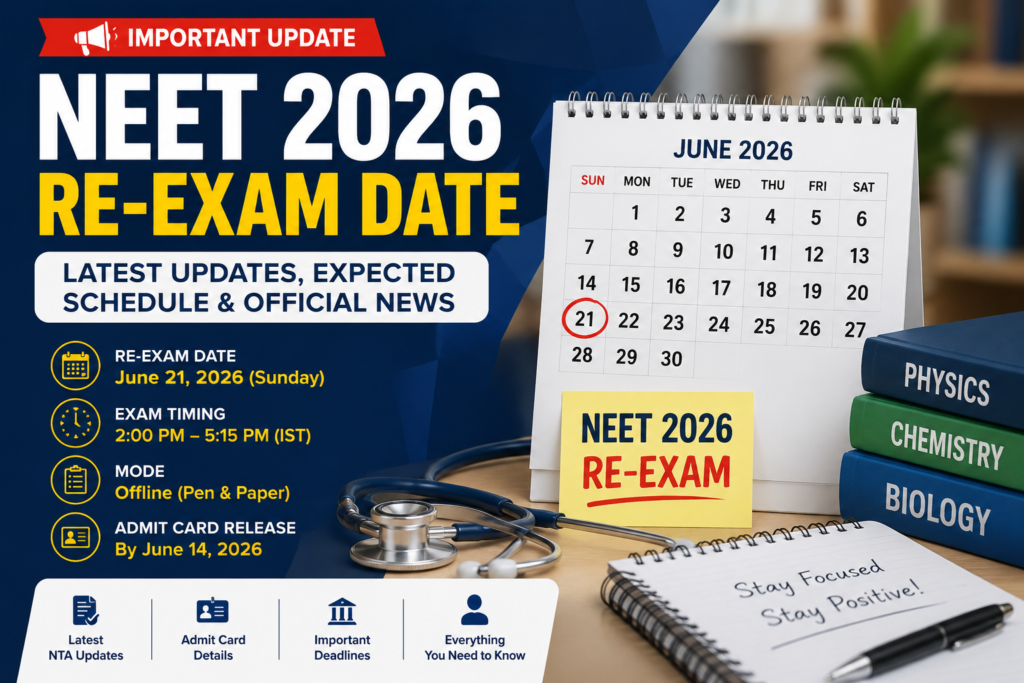
The NEET 2026 exam date has become one of the most searched topics among medical aspirants after the National Testing Agency (NTA) officially cancelled the earlier examination conducted on May 3, 2026. Following serious allegations of paper leaks and exam irregularities, lakhs of students across India were left confused, stressed, and uncertain about their future.Now, with the announcement of the NEET UG 2026 re-exam date, students are actively searching for official updates, admit card details, city correction deadlines, and preparation strategies for the fresh examination. In this article, we bring you the latest official news, expected schedule, important deadlines, and everything candidates must know about the NEET 2026 re-examination.Students who are still unfamiliar with the medical entrance process can also read our detailed guide on What is NEET? Full Guide for Students (2026). NEET 2026 Re-Exam: Key Dates at a Glance Event Date / Details Original Exam Date May 3, 2026 (Cancelled) Re-Exam Date June 21, 2026 (Sunday) Exam Timing 2:00 PM to 5:15 PM (IST) — 195 minutes Mode Offline (Pen and Paper) in 13 languages City Change Window Closes May 21, 2026 (11:50 PM) Admit Card Release By June 14, 2026 Registration Fee No fresh registration required Exam Fee Refund Full refund for May 3 fees The original NEET UG 2026 examination conducted on May 3, 2026, was cancelled following the surfacing of serious evidence that the integrity of the exam had been compromised. Multiple reports confirmed instances of leaked question papers circulating before the actual test. The controversy triggered widespread outrage among lakhs of medical aspirants across India. As a result, in a press conference held on May 15, 2026, the NTA officially announced that: The May 3, 2026 exam results would be scrapped entirely. A fresh re-examination would be conducted for all registered candidates. No new registration would be required, and no additional fee would be charged. The exam fees paid for the May 3 test would be fully refunded. The NTA has extended the exam duration by 15 minutes specifically to accommodate pre-examination formalities and ensure a smooth entry process at all test centres nationwide. NEET 2026 Re-Exam Admit Card: When Will It Be Released? Fresh admit cards for the NEET UG 2026 re-examination are expected to be released by June 14, 2026. Candidates must download their new admit card from the official NTA NEET portal. The earlier admit cards issued for the May 3 exam will not be valid for the re-exam. Steps to download the NEET 2026 Re-Exam Admit Card: Visit the official NTA NEET portal: neet.nta.nic.in Click on the ‘Download Admit Card’ link for the re-examination. Enter your Application Number and Date of Birth. Download and take a printout of the admit card for exam day. City Change Window for NEET 2026 Re-Exam In a significant relief to candidates, the NTA has opened a special City Change Window, allowing students to update their present address and modify their exam city preference for the re-examination. This correction window closes on May 21, 2026 (11:50 PM). Candidates who wish to appear from a different city must act before this deadline. Registration & Fees: What Candidates Need to Know One of the most reassuring announcements from NTA is the fee structure for the re-examination: No fresh registration is required for the re-exam. Candidates who appeared in the May 3, 2026 exam are automatically registered for the re-exam. No new fees will be charged for the re-examination. The original exam fees paid for the May 3 test will be fully refunded to all candidates. How to Prepare for NEET 2026 Re-Exam in the Remaining Time With the re-exam scheduled for June 21, 2026, candidates now have a valuable window to consolidate their preparation.Here are some strategic tips: Revise NCERT thoroughly — Biology, Physics, and Chemistry chapters are non-negotiable. Focus on weak areas identified from the May 3 exam attempt. Practice full-length mock tests under timed conditions (195 minutes). Revisit previous years’ NEET question papers (2018–2025) for pattern familiarity. Avoid new topics; consolidate what you already know. Maintain a healthy routine — adequate sleep and nutrition are critical during exam prep. Candidates preparing for the re-exam can also check our complete analysis on How Many Marks Are Required in NEET for MBBS? How FenceMbbsEdu Can Help You At FenceMbbsEdu, we are committed to keeping every NEET aspirant informed and prepared with: Live updates on NEET 2026 exam date announcements and NTA notifications. Free and premium NEET mock tests aligned with the latest NTA pattern. Expert-curated subject-wise study material for Biology, Physics, and Chemistry. Counselling guidance for MBBS admissions in India and abroad. One-on-one mentorship sessions with experienced NEET faculty. Bookmark this page and follow us on social media for real-time updates on the NEET 2026 re-exam date, admit card, and result announcements. Contact Us Book Your Free MBBS Counseling FAQs: NEET 2026 Re-Exam Date Q1. What is the NEET 2026 re-exam date? The NEET UG 2026 re-exam is officially scheduled for June 21, 2026 (Sunday). Q2. Why was the NEET 2026 exam cancelled? The original May 3, 2026 exam was cancelled due to confirmed allegations of question paper leaks and serious exam irregularities. Q3. Do I need to register again for the NEET 2026 re-exam? No. All candidates who registered for the May 3 exam are automatically eligible for the re-exam. No new registration or fee is required. Q4. When will the NEET 2026 re-exam admit card be released? Fresh admit cards are expected to be available by June 14, 2026 on the official NTA portal. Q5. Can I change my exam city for the re-exam? Yes. The NTA has opened a City Change Window that closes on May 21, 2026 (11:50 PM). Candidates must update their preferences before this deadline. How FenceMbbsEdu Can Help You At FenceMbbsEdu, we are committed to keeping every NEET aspirant informed and prepared with: Live updates on NEET 2026 exam date announcements and NTA notifications. Free and premium NEET mock tests aligned with the latest NTA pattern. Expert-curated subject-wise study
What is NEET? Full Guide for Students (2026) – Exam Pattern, Marks & Eligibility
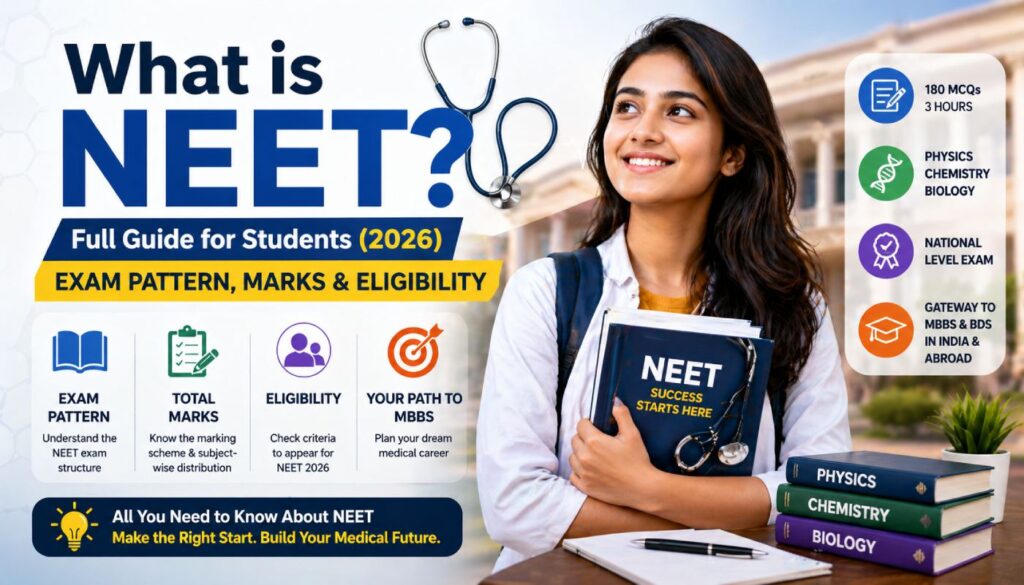
Choosing a career in medicine is a dream for thousands of students in India, and the first step toward that goal is clearing the NEET exam. Every year, lakhs of aspirants appear for this highly competitive test, aiming to secure admission into top medical colleges. However, many students and parents still have basic questions about the exam structure, eligibility, and what comes next. In this complete guide, you will understand what is NEET, its exam pattern, total marks, eligibility criteria, and how it shapes your journey toward becoming a doctor.If you’re planning your next steps, you can also read our detailed guide on What to Do After NEET Results to make a smart decision. What is NEET? NEET (National Eligibility cum Entrance Test) is the only national-level entrance examination in India for admission into undergraduate medical courses such as MBBS, BDS, and other allied healthcare programs. If you’re wondering what is the full form of NEET or NEET full form, it stands for National Eligibility cum Entrance Test. It is conducted by the National Testing Agency (NTA) and is mandatory for students who wish to study medicine in India or even pursue MBBS abroad. The exam ensures a standardized and fair selection process across the country, replacing multiple state and institutional-level entrance exams. Why is NEET Important? Understanding the importance of NEET helps students realize why this exam plays such a crucial role in shaping their medical career. It is not just an entrance test—it directly impacts your college options, career path, and future opportunities. Here’s why NEET is important: It is the only gateway to MBBS and BDS admissions in India Required for studying MBBS abroad as per NMC guidelines Determines your rank and college allotment Ensures transparent and merit-based selection Accepted by government, private, and deemed universities NEET Exam Pattern 2026 Before starting preparation, it is essential to understand the structure of the exam. A clear understanding of the exam pattern helps you manage time effectively and focus on high-scoring areas. It also allows you to plan your study strategy more efficiently and avoid unnecessary mistakes during the exam. Knowing the format in advance can boost your confidence and improve your overall performance. Here’s a quick overview of the NEET exam pattern: Mode of Exam: Offline (Pen & Paper-based) Total Marks: 720 Subjects: Physics, Chemistry, Biology (Botany + Zoology) Total Questions: 180 MCQs Duration: 3 hours Marking Scheme: +4 for correct answer, -1 for wrong answer Biology carries the highest weightage, so focusing on this subject can significantly improve your overall score. NEET Total Marks & Subject-wise Distribution Before diving into preparation, it’s important to clearly understand how marks are allocated across different subjects in NEET. A proper understanding of this distribution helps students focus on high-weightage areas and build a smarter study strategy. To score well in NEET, students must understand how marks are distributed across subjects. This helps in setting priorities and maximizing scoring potential. Here is the subject-wise breakdown: Biology (Botany + Zoology): 360 marks Chemistry: 180 marks Physics: 180 marks Total: 720 marks Since Biology contributes 50% of the total marks, it plays a major role in determining your rank. NEET Eligibility Criteria 2026 Before applying for NEET, students must ensure they meet the required eligibility criteria. These conditions are important for both appearing in the exam and securing admission later. Here are the key eligibility requirements: Must have completed 10+2 with Physics, Chemistry, and Biology (PCB) Minimum 50% marks for General category Minimum 40% marks for SC/ST/OBC categories Must be at least 17 years old at the time of admission No upper age limit (as per latest guidelines) Meeting these criteria ensures that you are eligible for NEET and further admission processes. How Many Marks Are Required in NEET? One of the most common questions students ask is about the marks required to secure an MBBS seat. The answer depends on multiple factors such as category, competition level, and type of college. Based on recent trends: 600+ marks: Strong chances for government medical colleges 500–600 marks: Possible government or semi-government colleges 350–500 marks: Private medical colleges Below 350 marks: MBBS abroad becomes a practical option If you want a detailed breakdown, you can also read our guide on How Many Marks Are Required in NEET for MBBS (internal link). NEET Marks vs Rank (Approximate Idea) Understanding the relationship between marks and rank helps you set realistic targets during preparation. 650+ marks: Top 5,000 rank 600+ marks: Within ~20,000 rank 500+ marks: Around 1,00,000 rank 400+ marks: 2–3 lakh rank 300+ marks: 4–5 lakh rank These figures vary every year depending on exam difficulty and competition. What Happens After NEET? After the results are declared, many students feel confused about their next steps. It’s important to understand that your journey doesn’t end with NEET—it actually begins there. Here’s what happens next: Participate in NEET counselling (AIQ & State quota) Choose colleges based on rank and preferences Secure admission in government or private colleges Explore alternatives like MBBS abroad if needed Making the right decision at this stage is critical for your future. What If You Don’t Get an MBBS Seat in India? Not securing an MBBS seat in India can be disappointing, but it should be viewed as a temporary setback rather than the end of your medical journey. With increasing competition and limited seats, many capable students explore alternative pathways that still lead to successful careers in medicine. By evaluating your situation carefully and understanding the available options, you can choose a path that aligns with your goals, budget, and long-term plans. Here are your options: Take a drop year and reattempt NEET Apply to private medical colleges Choose MBBS abroad in recognized universities Explore allied medical courses Why Many Students Choose MBBS Abroad With increasing competition in India, studying abroad is no longer just a backup—it has become a smart and strategic option. Read What to Do After NEET Results? Here’s why students are choosing this path: Affordable fees compared to
NEET UG 2026 Cancelled: Latest Updates, Re-Exam Details & What Students Should Do Next
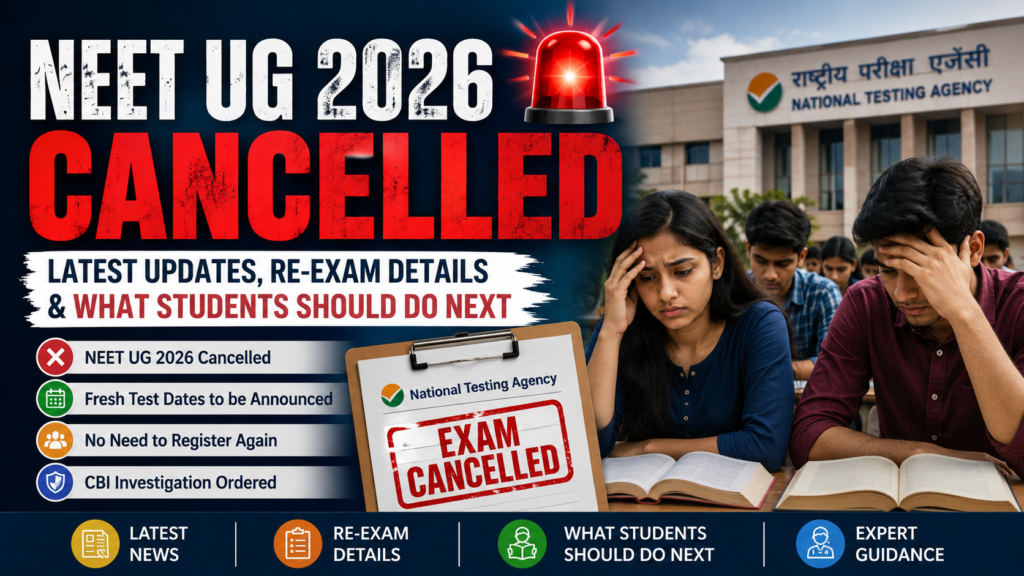
The cancellation of NEET UG 2026 has created massive concern among students, parents, and medical aspirants across India. With lakhs of students preparing for months—or even years—for one of the most competitive exams in the country, the recent developments surrounding the alleged paper leak have left many feeling confused and uncertain about their future.According to recent reports and official updates, the National Testing Agency (NTA) has cancelled the NEET UG 2026 examination conducted on 3 May 2026 following allegations of question paper leaks and irregularities. The decision has impacted nearly 24 lakh students who appeared for the exam.As investigations continue, students are now searching for answers regarding the NEET re-exam date, counselling delays, and what they should do next.In this guide, we will explain the latest updates, re-exam details, and the smart steps students should take during this situation. Why Was NEET UG 2026 Cancelled? The cancellation reportedly came after multiple allegations regarding the circulation of question papers before the examination. Inputs reviewed by authorities allegedly showed overlaps between circulated question sets and portions of the actual NEET UG 2026 paper.Reports also suggested that investigations were initiated in multiple states, with authorities examining coaching centers, intermediaries, and materials connected to the alleged leak.To maintain fairness, transparency, and public trust in the examination system, the authorities decided to cancel the existing examination process and conduct a fresh examination.The matter has also reportedly been handed over for further investigation by central agencies. Official Update on NEET UG 2026 Re-Exam Based on the latest announcements: NEET UG 2026 will be conducted again Fresh exam dates will be announced separately New admit cards will be issued Students will not need to register again No additional examination fee is expected Existing candidate data will remain valid Students are advised to rely only on official announcements and avoid misinformation circulating on social media platforms. What Should Students Do Right Now? The sudden cancellation has understandably created stress among aspirants. However, this is the time to stay calm and focus on what can be controlled rather than panicking over uncertainty.Students should treat this period as an opportunity to strengthen preparation and maintain consistency. Since the re-exam may happen within a limited timeframe, staying academically active is extremely important.Here are some smart steps students should follow: Continue regular NEET preparation Revise Biology, Physics, and Chemistry consistently Avoid depending on unofficial rumors or fake updates Follow official NTA notifications only Maintain a healthy study routine and mental balance Stay prepared for quick announcements regarding new exam dates Will NEET Counselling Be Delayed? Since the examination process is expected to be conducted again, there is a possibility that the counselling timeline and admission process may also shift.This could impact: All India Quota (AIQ) counselling State quota counselling Private medical college admissions MBBS admission timelines for 2026 Students should remain updated regarding revised schedules and official counselling announcements.If you want to understand the complete counselling process, you can also read our guide on What to Do After NEET Results? How This Situation Impacts MBBS Aspirants The cancellation has created uncertainty, especially for students aiming for government medical colleges. With intense competition already present in NEET, students may now face additional pressure due to changing schedules and exam-related anxiety. However, students must remember that this situation affects everyone equally. The best approach right now is to stay focused and continue preparation without losing momentum.Many students are also reassessing their backup plans and exploring additional opportunities beyond traditional options. What If You Don’t Want to Risk Another Year? For many students, repeated uncertainty and increasing competition have highlighted the challenges of securing an MBBS seat in India.This is one of the reasons why many aspirants are now considering alternatives such as: Private medical colleges Semi-government colleges MBBS abroad programs Allied healthcare courses Among these options, MBBS abroad has become increasingly popular due to affordable tuition fees, global exposure, and comparatively easier admission pathways.You can also explore: What is NEET? Full Guide for Students (2026) How Many Marks Are Required in NEET for MBBS? Top Medical Colleges in Philippines for Indian Students Why Many Students Are Exploring MBBS Abroad With rising competition, limited government seats, and ongoing uncertainties around entrance examinations, studying MBBS abroad has become a practical choice for many Indian students. Some of the major advantages include: Affordable education compared to private colleges in India Globally recognized medical degrees English-medium curriculum in many countries No donation or capitation fees Easier admission process after NEET qualification Countries like the Philippines have become especially popular among Indian students due to student-friendly education systems and strong clinical exposure. Important Advice for Students & Parents Situations like these can create emotional pressure, confusion, and fear about the future. However, making rushed decisions during uncertain times can often lead to mistakes.Students and parents should focus on: Staying informed through official sources Avoiding panic-based decisions Keeping multiple options open Planning long-term career goals wisely Seeking proper academic guidance when needed Remember, one exam situation does not define your entire medical career. Frequently Asked Questions (FAQs) Is NEET UG 2026 officially cancelled? According to recent reports and official updates, the NEET UG 2026 examination conducted in May 2026 has reportedly been cancelled due to allegations related to paper leaks and examination irregularities. Will NEET UG 2026 be conducted again? Yes, authorities are expected to conduct a fresh NEET UG 2026 examination with revised dates and updated admit cards. Do students need to register again for the NEET re-exam? As per current updates, students may not need fresh registration, and existing application data is expected to remain valid. Will NEET counselling be delayed? There is a possibility that counselling and admission timelines may shift due to the re-examination process. What should students do after the NEET cancellation news? Students should continue preparation, avoid panic, follow official updates, and stay academically consistent while waiting for revised exam dates. Final Thoughts The NEET UG 2026 cancellation has undoubtedly created uncertainty for millions of students. However, this phase should be viewed as
What to Do After NEET Results? Complete Guide 2026

Choosing what to do after NEET results can feel overwhelming for many students. After months or even years of preparation, your score finally decides the direction of your medical career. But here’s the truth—your NEET result is not the end, it’s just the beginning of your journey.Every year, lakhs of students appear for NEET, yet only a small percentage secure MBBS seats—especially in government colleges. This leaves many students confused about their next step. Should you go for counselling, take a drop, choose a private college, or consider studying MBBS abroad?In this complete guide, you will understand what to do after NEET results in 2026, explore all available options, and make a smart decision for your future. What is NEET? Before making any decision, it’s important to understand the exam itself. NEET (National Eligibility cum Entrance Test) is the national-level entrance exam required for admission into MBBS, BDS, and other medical courses in India. The exam is based on Physics, Chemistry, and Biology and is conducted out of a total of 720 marks. Your score and rank determine your eligibility for medical colleges across India. Since NEET is the only gateway for medical admissions, your performance directly impacts your opportunities—but it doesn’t define your entire future. Understanding Your NEET Result First Before jumping to conclusions, take time to properly analyze your result. Focus on: Your NEET score Your All India Rank (AIR) Your category rank Previous year cutoff trends Step 1: Participate in NEET Counselling The first and most important step after NEET results is participating in the counselling process. This is where medical seats are allotted based on your rank and preferences. Types of Counselling All India Quota (AIQ) – 15% seats State Quota – 85% seats Deemed & Private Universities Counselling Even if your score is not very high, you should still participate, as cutoffs can vary and opportunities may arise in later rounds. NEET Counselling Process (Step-by-Step Guide) Understanding the counselling process can help you avoid mistakes and increase your chances of securing a seat. Step 1: RegistrationUnderstanding the counselling process can help you avoid mistakes and increase your chances of securing a seat.Step 2: Choice Filling Select colleges and courses based on your preference and rank. This step plays a crucial role in your admission. Step 3: Seat Allotment Seats are allotted based on rank, category, and choices filled.Step 4: Reporting to College If allotted a seat, you must confirm your admission by reporting to the college. Step 5: Upgradation (Optional) You can participate in further rounds to get a better college if needed. Important Tips for Counselling Fill as many choices as possible Do not skip counselling rounds Keep all documents ready Make informed decisions before locking choices Step 2: Know Your Chances Based on Score Your NEET score plays a major role in deciding your options. Here’s a general idea: 600+ Marks Strong chances for government medical colleges Access to top colleges 500–600 Marks Possible government seat (depending on category/state) Good semi-government options 350–500 Marks Limited government chances Private colleges become a key option Below 350 Marks Government seat unlikely Consider alternative paths like MBBS abroad Step 3: Explore All Your Options After understanding your score, the next step is to choose the best path forward. Option 1: Government Medical Colleges (Best Option) Government colleges are highly preferred due to: Affordable fees High-quality education Strong academic reputation However, limited seats and intense competition make admission challenging. Option 2: Private Medical Colleges in India Private colleges are a practical option for students with moderate scores. Pros: Easier admission compared to government colleges No need to drop a year Cons: High fees (₹80 lakh – ₹1.5 crore) Financial burden for many families Option 3: Drop a Year and Reattempt NEET Taking a drop year is a common choice for many students. When it makes sense: Your score is close to the cutoff No need to drop a year Risks: No guarantee of better results Increased competition and pressure Option 4: Study MBBS Abroad (Smart Alternative) Studying MBBS abroad has become a popular option for students who qualify NEET but don’t secure a seat in India. Benefits: Affordable fees compared to private colleges Globally recognized degrees No donation required Simple admission process Why the Philippines Is a Preferred Choice Among various countries, the Philippines has emerged as a top destination for Indian students. Its education system is aligned with global standards while remaining accessible and student-friendly. The curriculum emphasizes both theoretical learning and practical exposure, helping students adapt easily and build strong clinical skills. Key Advantages: English-medium education US-based curriculum High FMGE/NEXT success rate Strong clinical exposure Easy adaptation for Indian students NEET Qualification vs Admission Reality One of the biggest misunderstandings is that qualifying NEET guarantees an MBBS seat. Reality: NEET qualification = Eligibility for counselling Admission = Depends on rank, seats, and competition This is why many students with decent scores still do not secure admission in India. Common Mistakes Students Make After NEET Results Avoid these mistakes to make a better decision: Waiting too long to take action Focusing only on government colleges Ignoring financial planning Taking a drop without a strategy Not seeking proper guidance Smart Strategy After NEET Results After NEET results, many students feel confused or pressured to make quick decisions. However, rushing without a proper plan can lead to mistakes that affect your future. Instead of focusing only on your score, it’s important to take a structured and practical approach that aligns with your career goals.Instead of panicking, follow a clear plan: Analyze your score carefully Participate in counselling Keep backup options ready Compare India vs abroad options Make decisions based on long-term goals Quick Comparison: India vs Abroad Factor Government College Private College MBBS Abroad Fees Low Very High Affordable Competition Very High Medium Low Admission Difficult Moderate Easy NEET Requirement High Score Moderate Qualifying Only Frequently Asked Questions (FAQs) How many marks are required in NEET for MBBS? The marks required in NEET for MBBS depend
How Many Marks Are Required in NEET for MBBS? What If Your Score Is Low?

Choosing a medical career is a dream for thousands of students in India, and the NEET (National Eligibility cum Entrance Test) is the gateway to that dream. Every year, lakhs of students appear for NEET, yet only a small percentage secure MBBS seats, especially in government colleges. High competition, limited seats, and rising cutoffs make the journey challenging.One of the most common questions students ask is:How many marks are required in NEET for MBBS?In this complete guide, you’ll understand the minimum marks in NEET for MBBS, expected cutoffs, and most importantly—what you can do if your score is low. NEET Total Marks and Exam Overview Before understanding the required marks, it’s important to know the structure of the exam. NEET Total Marks: 720 Subjects: Physics, Chemistry, Biology Biology Weightage: Highest (Botany + Zoology) Type: Multiple Choice Questions (MCQs) Even a small difference in marks can significantly affect your rank, which directly impacts your admission chances. How Many Marks Are Required in NEET for MBBS? The answer depends on category, competition, and type of college. Based on recent trends, here’s a realistic estimate: 1. Minimum Marks for Government Medical Colleges (India) General Category: 610–650+ marks (safe score) OBC/EWS: 530–640+ marks (varies by state quota) SC/ST: 420–570+ marks (depending on cutoff trends) Government colleges are highly preferred due to low fees and strong reputation. However, limited seats and intense competition make admission extremely difficult—even a small drop in marks can impact your chances. 2. Minimum Marks for Private Medical Colleges (India) General Range: 350–550+ marks Admission is more accessible compared to government colleges, but top private institutions may still require higher scores and involve a significant financial investment. 📌 Key Insight If you’re still wondering how many marks are required in NEET for MBBS, the safe score for a government seat is usually above 600 marks, while private colleges may accept lower scores. Minimum Marks in NEET for MBBS (Qualifying vs Admission) The minimum marks in NEET for MBBS vary every year depending on cutoff trends. General Category: ~137+ OBC/SC/ST: ~107+ ⚠️ Important: Qualifying NEET does NOT guarantee an MBBS seat. It only makes you eligible for counseling. NEET Marks vs Rank (Approximate Idea) Marks Range Expected Rank 650+ Top 5,000 600+ Top 20,000 500+ Top 1,00,000 400+ 2–3 lakh 300+ 4–5 lakh Why Many Students Don’t Get MBBS Seats in India Even after scoring decent marks, many students fail to secure a seat due to: Limited government seats High cutoff scores Expensive private colleges Reservation and state quota factors This is why understanding the minimum marks required in NEET for MBBS is crucial before planning your next step. What If Your NEET Score Is Low? This is where most students feel confused and stressed—but the truth is: A low NEET score does NOT mean the end of your medical dream. Let’s explore your options 👇 Difficulty understanding lectures Communication issues with patients Limited clinical learning Option 1: Drop a Year and Reattempt NEET You can prepare again and try to improve your score. ✔ Pros: Chance to get a government seat Improve score Better rank next year ❌ Cons: Time-consuming No guarantee of improvement High pressure and competition Option 2: Private Medical Colleges in India If your score is moderate, you may get admission in private colleges. ✔ Pros: Easier admission No need to drop a year ❌ Cons: Very high fees (₹80L–₹1.5Cr) Limited ROI for many students Option 3: Study MBBS Abroad (Best Alternative) For many students, studying MBBS abroad has become a smart and practical solution. ✔ Benefits: Affordable fees compared to India Globally recognized degrees High-quality education No donation required India vs Abroad – Smart Comparison Factor India (Govt) India (Private) Abroad Marks Required 600+ 350–550 NEET Qualified Fees Low Very High Affordable Competition Very High Medium Low Admission Difficulty Hard Moderate Easy This clearly shows why many students are now exploring MBBS abroad. Why the Philippines 🇵🇭 Is a Smart Choice Among various countries, the Philippines stands out as a preferred destination for Indian students. ✔ Key Advantages: English-medium education US-based curriculum High FMGE/NEXT success rate Strong clinical exposure Easy lifestyle adaptation It offers a practical pathway for students who qualify NEET but may not secure a seat in India, allowing them to continue their medical journey without unnecessary delays. NEET Requirement for MBBS Abroad To pursue MBBS abroad, the eligibility requirements are simple and student-friendly compared to India. Most universities focus on basic qualification rather than extremely high scores, making it a practical option for many students. ✔ Basic Requirements: NEET qualification (high score not mandatory) Minimum 50% in PCB (40% for reserved categories) Valid passport and required documents This means even with an average NEET score, students still have a strong opportunity to pursue their dream of becoming a doctor through recognized international universities. Smart Strategy for Students While NEET marks play an important role, making the right decisions beyond scores is what truly shapes your medical career. A well-planned approach can open better opportunities, even if your score is not very high. Choose the right country Select a recognized university Ensure clinical exposure Plan finances wisely Understanding how many marks are required in NEET for MBBS is important, but choosing the right path is even more important. Final Thoughts The question how many marks are required in NEET for MBBS does not have a one-size-fits-all answer. It depends on your goals, category, and the type of college you are targeting. 600+ → Government colleges Lower score → Private or abroad options The key is to make a smart decision based on your situation—not just your score. Ready to Take the Next Step? Don’t let your NEET score limit your dreams. Explore the best options available and choose the path that suits you. Contact Us Book Your Free MBBS Counseling
Top 7 Mistakes Indian Students Make While Choosing MBBS Abroad
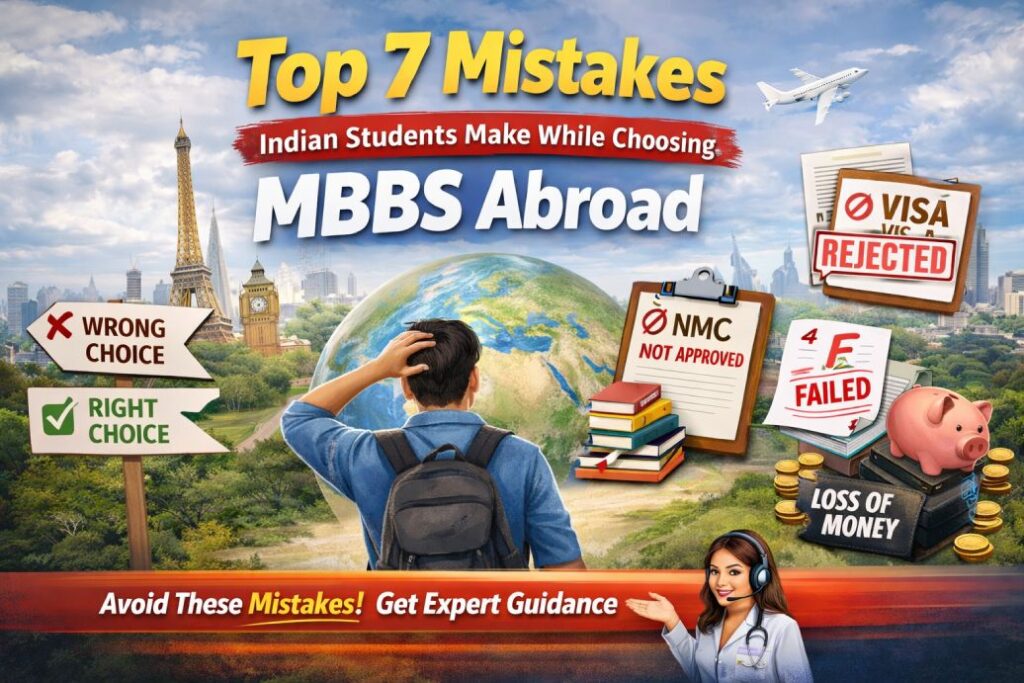
Choosing to pursue MBBS abroad is a life-changing decision for many Indian students. With limited government seats and high fees in private colleges in India, studying medicine overseas has become a practical and popular option. However, while the opportunity is promising, many students make critical mistakes during the decision-making process—mistakes that can affect their career, finances, and future medical practice.This guide will help you understand the top 7 mistakes Indian students make while choosing MBBS abroad, and more importantly, how to avoid them. Making the right choice today can shape your entire medical career tomorrow. Why Choosing the Right Country and University Matters Studying MBBS abroad is not just about getting admission—it’s about building a strong foundation for your future as a doctor. The country you choose, the university you enroll in, and the support system you have will directly impact: Your quality of education Your ability to clear licensing exams like NEXT/FMGE Your clinical exposure and practical knowledge Your career opportunities globally A wrong decision can lead to wasted years, financial loss, and career setbacks. That’s why it’s important to make an informed and strategic choice. Mistake #1: Choosing a University Without NMC Recognition ❌ The Problem One of the most common mistakes students make is selecting a university that is not approved by the National Medical Commission (NMC). Many students are attracted by low fees or easy admission and overlook this critical factor. ⚠️ Why It’s Risky If your university is not recognized by NMC: You will not be eligible to practice in India You may not be allowed to appear for NEXT/FMGE Your medical degree may not hold value in India ✅ What You Should Do Always verify whether the university is: NMC-approved Listed with WHO and WFME Meeting all eligibility criteria set by Indian authorities Tip: A trusted consultancy can help you shortlist only approved and recognized universities, ensuring your degree is valid. Mistake #2: Ignoring the Importance of FMGE/NEXT Preparation ❌ The Problem Many students choose a country or university without considering how well it prepares them for FMGE/NEXT exams. ⚠️ Why It’s Risky Even if you complete your MBBS abroad, you must clear NEXT/FMGE to practice in India. Without proper preparation: Your chances of passing the exam decrease You may need extra coaching after graduation Your career progression gets delayed ✅ What You Should Do Choose universities that: Follow a curriculum aligned with Indian standards Offer FMGE/NEXT-oriented teaching Provide strong academic support and guidance Tip: Countries like the Philippines are preferred because of their curriculum alignment and English-medium education. Mistake #3: Falling for Extremely Low Fees ❌ The Problem Students often get attracted to universities offering very low fees without checking the quality of education. ⚠️ Why It’s Risky Low-cost options may come with: Poor infrastructure Limited clinical exposure Low-quality faculty Hidden charges later ✅ What You Should Do Instead of focusing only on fees: Compare value for money (education + facilities) Check hospital affiliations and clinical exposure Understand the complete cost (tuition + living + extras) Tip: Remember, investing in quality education is investing in your future. Mistake #4: Not Checking Clinical Exposure and Hospital Facilities ❌ The Problem Many students ignore the importance of practical training and hospital exposure while selecting a university. ⚠️ Why It’s Risky Medical education is not just theoretical. Without proper clinical exposure: You won’t gain real patient-handling experience Your practical knowledge will remain weak You may struggle in real-world medical practice ✅ What You Should Do Always check: Number of affiliated hospitals Patient flow and case diversity Availability of hands-on training Tip: A good medical university should provide strong clinical training from early years. Mistake #5: Choosing a Country Without Considering Language Barriers ❌ The Problem Some students choose countries where the medium of instruction is not English. ⚠️ Why It’s Risky Language barriers can create serious challenges: Difficulty understanding lectures Communication issues with patients Limited clinical learning ✅ What You Should Do Prefer countries where: The medium of teaching is English Patients also speak English Tip: This ensures better learning and smoother clinical experience. Mistake #6: Ignoring Safety, Lifestyle & Student Support ❌ The Problem Students often focus only on academics and ignore factors like safety, accommodation, and lifestyle. ⚠️ Why It’s Risky Studying abroad involves living independently. Poor living conditions can lead to: Stress and discomfort Health issues Difficulty focusing on studies ✅ What You Should Do Check for: Safe and student-friendly environment Availability of Indian food Hostel facilities and security On-ground support for international students Tip: A comfortable environment helps you focus better on your studies. Mistake #7: Applying Without Proper Guidance ❌ The Problem Many students try to handle the entire admission process on their own or rely on unreliable agents. ⚠️ Why It’s Risky This can lead to: Wrong university selection Documentation errors Visa rejection Financial loss ✅ What You Should Do Work with a trusted and experienced consultancy that: Provides transparent guidance Helps with admission, visa, and travel Offers end-to-end support Tip: The right guidance can save you time, money, and stress. How to Avoid These Mistakes – Expert Advice Choosing MBBS abroad is a big decision, but avoiding these common mistakes can make your journey smooth and successful. Here’s what you should focus on: Always verify university recognition (NMC, WHO) Choose a country with English-medium education Ensure strong clinical exposure and hospital training Plan your budget carefully without compromising quality Seek expert guidance before making any decision Why Indian Students Prefer MBBS in Philippines Among the many options available for pursuing a medical degree abroad, the Philippines has become a highly preferred destination for Indian students. The education system offers a strong balance of academic excellence, practical training, and a student-friendly environment. With globally aligned standards and a comfortable lifestyle, students can focus better on their studies and career growth. As a result, MBBS in Philippines continues to attract Indian students aiming for a successful medical future. English-medium education system US-based curriculum High FMGE/NEXT success rate Affordable fee structure
Top Medical Colleges in Philippines for Indian Students

Choosing the right medical college is one of the most important decisions for any aspiring doctor. With limited seats and high competition in India, many students are now exploring global opportunities. Among all international destinations, the Philippines stands out due to its affordability, English-medium education, and globally recognized medical degrees.In this blog, we will explore the Top Medical Colleges in the Philippines for Indian Students to help you make the right decision for your future. Why Choose Philippines for MBBS? The Philippines has become a hub for medical education, especially for Indian students. Here’s why: Affordable fee structure compared to private medical colleges in India English-medium education (no language barrier) High FMGE/NExT passing ratio Globally recognized medical degrees Safe and student-friendly environment Why Choose Philippines for MBBS? For students searching for a Philippine medical college for Indian students, the country offers the perfect combination of affordability and quality. Top Medical Colleges in Philippines for Indian Students 1. University of Perpetual Help System DALTA (UPHSD) The University of Perpetual Help System DALTA (UPHSD) is one of the most prestigious institutions in the Philippines, known for its commitment to academic excellence and professional development. Established in 1975, the university has consistently maintained high standards in medical education and research. It offers a well-structured curriculum aligned with global medical practices, making it highly suitable for Indian students. UPHSD is especially preferred by students looking for a reliable and future-focused Philippines medical college for Indian students.Key Highlights: Established in 1975 with a strong academic legacy Autonomous Status granted by CHED (Philippines) Globally aligned medical curriculum Advanced laboratories and modern infrastructure Highly qualified and experienced faculty Strong focus on clinical and practical training source “www.perpetualdalta.edu.ph/new” 2. AMA School of Medicine AMA School of Medicine is recognized for its innovative approach to medical education, integrating technology with traditional learning methods. The institution focuses on providing students with a modern and flexible learning environment. It has gained popularity among Indian students due to its affordability and emphasis on digital learning systems. It is considered a reliable Philippines medical college for students aiming for a tech-enabled medical education.Key Highlights: US-based medical curriculum Technology-driven learning environment Affordable tuition fees Strong clinical exposure programs Modern teaching methodologies source “www.amaschoolofmedicine.com” 3. Davao Medical School Foundation (DMSF) Davao Medical School Foundation is one of the most preferred choices among Indian students due to its excellent academic reputation and consistent results. The college emphasizes practical knowledge and hands-on training, which helps students perform well in licensing exams. Its student-friendly environment and experienced faculty make it a strong contender among the best medical college options in the Philippines. Key Highlights: High FMGE/NExT success rate Experienced and supportive faculty Strong focus on clinical training Well-established academic system Indian student-friendly environment source “www.dmsf.net” 4. Our Lady of Fatima University (OLFU) Our Lady of Fatima University is a well-established institution known for providing quality education across multiple disciplines, including medicine. It offers a balanced approach to theoretical and practical learning, ensuring students gain complete medical knowledge. The university has a strong global reputation and continues to attract students looking for a dependable Philippines medical college for Indian students.Key Highlights: Recognized and globally accepted degree Advanced teaching methodologies Strong clinical exposure Well-developed campus infrastructure Diverse international student community source “www.fatima.edu.ph” 5. UV Gullas College of Medicine UV Gullas College of Medicine is widely known for offering affordable medical education without compromising on quality. It has become a preferred choice for students who are looking for budget-friendly options abroad. The college provides a supportive academic environment along with modern facilities, making it a good Philippines medical college for Indian students.Key Highlights: Cost-effective fee structure English-medium education Student-friendly campus environment Modern infrastructure and facilities Focus on academic and clinical excellence source “www.uvgullasmedicalcollege.com” 6. Emilio Aguinaldo College Emilio Aguinaldo College has built a strong reputation for delivering quality medical education with a focus on practical training. The institution provides students with hands-on experience through its affiliated hospitals and clinical programs. It is recognized by various global medical bodies, making it a trustworthy choice among the best medical college options.Key Highlights: Recognized by international medical bodies Strong hospital-based training programs Experienced teaching faculty Emphasis on practical learning Well-equipped medical facilities source “www.future-mbbs.com” Recommended Best Medical College for MBBS If you are seriously planning to study in one of the Top Medical Colleges in the Philippines for Indian Students , then one name clearly stands above the rest — University of Perpetual Help System DALTA (UPHSD) . But what truly makes UPHSD special is not just its legacy — it’s the complete student experience. Imagine studying in a university where everything is designed to help you succeed: modern labs, experienced professors, global curriculum, and a strong focus on practical learning. From your first day itself, you start feeling like a future doctor, not just a student. What makes UPHSD even more attractive for Indian students is its perfect balance of quality + affordability + global exposure. While many students get confused choosing the right Philippine medical college for Indian students, UPHSD removes that confusion by offering a structured, trusted, and career-oriented pathway.And the best part? With the right guidance from experts like Fence Education Consultancy Inc., getting into UPHSD becomes smooth, transparent, and stress-free. If your goal is not just to study MBBS, but to build a strong medical career globally, then UPHSD is undoubtedly the best medical college choice to consider. Eligibility Criteria for Indian Students To study in the Philippines, students must meet the following criteria: Minimum 50% marks in PCB (40% for reserved category) NEET qualification is mandatory Age should be at least 17 years Valid passport and required academic documents (10th & 12th mark sheets, certificates) Medical fitness certificate as per university and visa requirements Proficiency in English (basic communication skills required for academic understanding) Advantages for Indian Students English-Medium Education US-Based Medical Curriculum Affordable Fee Structure NMC & WHO Recognized Universities Extensive Clinical Exposure Easy Adaptation for Indian Students Strong FMGE/NExT Preparation You’re not just going abroad—you’re