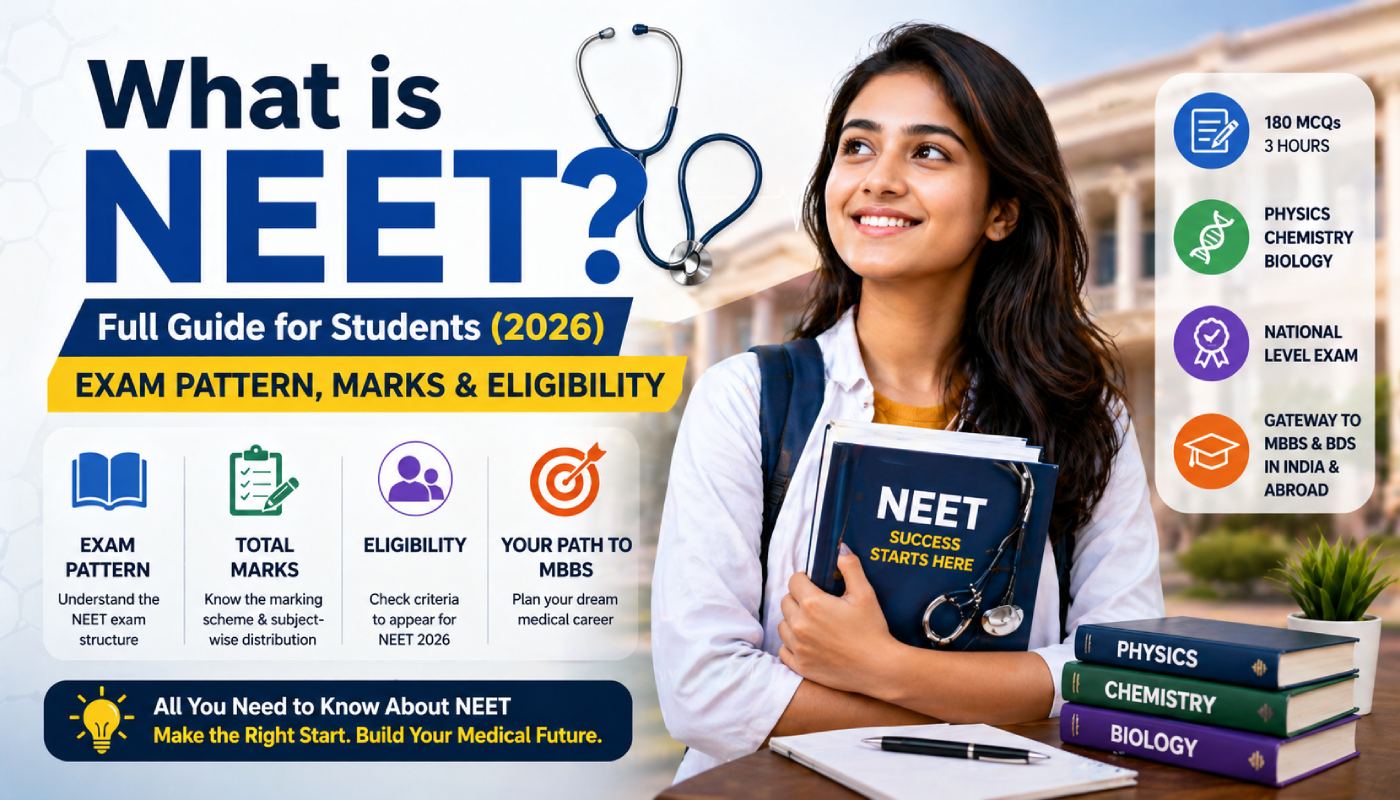
Choosing a career in medicine is a dream for thousands of students in India, and the first step toward that goal is clearing the NEET exam. Every year, lakhs of aspirants appear for this highly competitive test, aiming to secure admission into top medical colleges. However, many students and parents still have basic questions about the exam structure, eligibility, and what comes next.
In this complete guide, you will understand what is NEET, its exam pattern, total marks, eligibility criteria, and how it shapes your journey toward becoming a doctor.
If you’re planning your next steps, you can also read our detailed guide on What to Do After NEET Results to make a smart decision.
What is NEET?
NEET (National Eligibility cum Entrance Test) is the only national-level entrance examination in India for admission into undergraduate medical courses such as MBBS, BDS, and other allied healthcare programs.
If you’re wondering what is the full form of NEET or NEET full form, it stands for National Eligibility cum Entrance Test.
It is conducted by the National Testing Agency (NTA) and is mandatory for students who wish to study medicine in India or even pursue MBBS abroad.
The exam ensures a standardized and fair selection process across the country, replacing multiple state and institutional-level entrance exams.
Why is NEET Important?
Understanding the importance of NEET helps students realize why this exam plays such a crucial role in shaping their medical career. It is not just an entrance test—it directly impacts your college options, career path, and future opportunities.
Here’s why NEET is important:
- It is the only gateway to MBBS and BDS admissions in India
- Required for studying MBBS abroad as per NMC guidelines
- Determines your rank and college allotment
- Ensures transparent and merit-based selection
- Accepted by government, private, and deemed universities
NEET Exam Pattern 2026
Before starting preparation, it is essential to understand the structure of the exam. A clear understanding of the exam pattern helps you manage time effectively and focus on high-scoring areas. It also allows you to plan your study strategy more efficiently and avoid unnecessary mistakes during the exam. Knowing the format in advance can boost your confidence and improve your overall performance.
Here’s a quick overview of the NEET exam pattern:
- Mode of Exam: Offline (Pen & Paper-based)
- Total Marks: 720
- Subjects: Physics, Chemistry, Biology (Botany + Zoology)
- Total Questions: 180 MCQs
- Duration: 3 hours
- Marking Scheme: +4 for correct answer, -1 for wrong answer
Biology carries the highest weightage, so focusing on this subject can significantly improve your overall score.
NEET Total Marks & Subject-wise Distribution
Before diving into preparation, it’s important to clearly understand how marks are allocated across different subjects in NEET. A proper understanding of this distribution helps students focus on high-weightage areas and build a smarter study strategy.
To score well in NEET, students must understand how marks are distributed across subjects. This helps in setting priorities and maximizing scoring potential.
Here is the subject-wise breakdown:
- Biology (Botany + Zoology): 360 marks
- Chemistry: 180 marks
- Physics: 180 marks
- Total: 720 marks
Since Biology contributes 50% of the total marks, it plays a major role in determining your rank.
NEET Eligibility Criteria 2026
Before applying for NEET, students must ensure they meet the required eligibility criteria. These conditions are important for both appearing in the exam and securing admission later.
Here are the key eligibility requirements:
- Must have completed 10+2 with Physics, Chemistry, and Biology (PCB)
- Minimum 50% marks for General category
- Minimum 40% marks for SC/ST/OBC categories
- Must be at least 17 years old at the time of admission
- No upper age limit (as per latest guidelines)
Meeting these criteria ensures that you are eligible for NEET and further admission processes.
How Many Marks Are Required in NEET?
One of the most common questions students ask is about the marks required to secure an MBBS seat. The answer depends on multiple factors such as category, competition level, and type of college.
Based on recent trends:
- 600+ marks: Strong chances for government medical colleges
- 500–600 marks: Possible government or semi-government colleges
- 350–500 marks: Private medical colleges
- Below 350 marks: MBBS abroad becomes a practical option
If you want a detailed breakdown, you can also read our guide on How Many Marks Are Required in NEET for MBBS (internal link).
NEET Marks vs Rank (Approximate Idea)
Understanding the relationship between marks and rank helps you set realistic targets during preparation.
- 650+ marks: Top 5,000 rank
- 600+ marks: Within ~20,000 rank
- 500+ marks: Around 1,00,000 rank
- 400+ marks: 2–3 lakh rank
- 300+ marks: 4–5 lakh rank
These figures vary every year depending on exam difficulty and competition.
What Happens After NEET?
After the results are declared, many students feel confused about their next steps. It’s important to understand that your journey doesn’t end with NEET—it actually begins there.
Here’s what happens next:
- Participate in NEET counselling (AIQ & State quota)
- Choose colleges based on rank and preferences
- Secure admission in government or private colleges
- Explore alternatives like MBBS abroad if needed
Making the right decision at this stage is critical for your future.
What If You Don’t Get an MBBS Seat in India?
Not securing an MBBS seat in India can be disappointing, but it should be viewed as a temporary setback rather than the end of your medical journey. With increasing competition and limited seats, many capable students explore alternative pathways that still lead to successful careers in medicine. By evaluating your situation carefully and understanding the available options, you can choose a path that aligns with your goals, budget, and long-term plans.
Here are your options:
- Take a drop year and reattempt NEET
- Apply to private medical colleges
- Choose MBBS abroad in recognized universities
- Explore allied medical courses
Why Many Students Choose MBBS Abroad
With increasing competition in India, studying abroad is no longer just a backup—it has become a smart and strategic option.
Here’s why students are choosing this path:
- Affordable fees compared to private colleges in India
- Globally recognized degrees
- No donation or capitation fees
- English-medium education in many countries
- Easier admission with NEET qualification
Frequently Asked Questions (FAQs)
What is the full form of NEET?
The NEET full form is National Eligibility cum Entrance Test, which is the national-level exam for medical admissions in India.
Is NEET mandatory for MBBS?
Yes, NEET is compulsory for admission into MBBS programs in India and even for studying MBBS abroad as per NMC guidelines.
What are the total marks in NEET?
NEET is conducted for a total of 720 marks, covering Physics, Chemistry, and Biology.
Can I study MBBS abroad without NEET?
No, Indian students must qualify NEET to pursue MBBS abroad.
Final Thoughts
Understanding what is NEET is the first step toward building a successful medical career. While the exam is highly competitive, the right preparation strategy and decision-making can open multiple opportunities.
Your NEET score matters—but it does not define your entire future. Whether you secure admission in India or explore options abroad, the key is to choose the path that aligns with your goals.
Ready to Start Your Medical Journey?

Don’t let confusion or lack of guidance hold you back. Take the right step with proper planning and expert support.