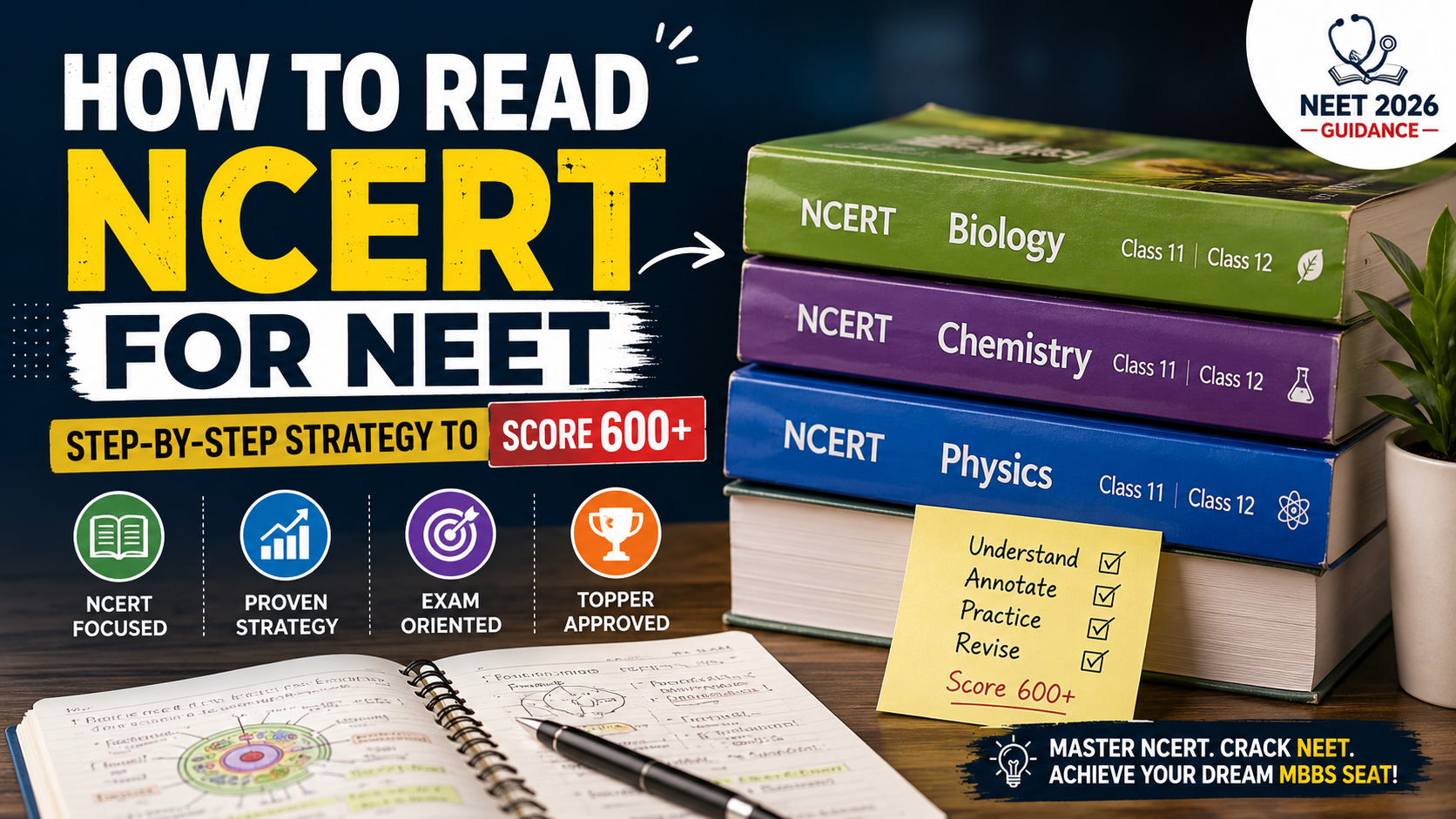
Why NCERT Is the Foundation of NEET Preparation
|
Subject |
NCERT Coverage in NEET |
Max Marks |
|
Biology |
~85–90% from NCERT |
360 marks |
|
Chemistry |
~70–75% from NCERT |
180 marks |
|
Physics |
~60–65% from NCERT concepts |
180 marks |
Which NCERT Books Do You Need for NEET?
- Biology Class 11 (Chapters 1–22)
- Biology Class 12 (Chapters 1–16)
- Chemistry Class 11 (Chapters 1–14)
- Chemistry Class 12 (Chapters 1–16)
- Physics Class 11 (Chapters 1–15)
- Physics Class 12 (Chapters 1–15)
How to Read NCERT for NEET: A Step-by-Step Strategy
Step 1: First Reading — Read for Understanding, Not Memorisation
- Read the chapter introduction carefully — it sets the context.
- Go through all headings and subheadings before starting.
- Read every line, including the small text under diagrams and in boxes.
- Do not skip In-Text Questions — they often contain NEET-relevant concepts.
- After finishing the chapter, read the summary at the end.
Step 2: Second Reading — Active Annotation & Highlighting
- Highlight definitions, scientific names, key terms, and important facts.
- Write short notes or keywords in the margins — known as active annotation.
- Mark tables separately — data and classifications are frequently tested.
- Place a star next to anything that surprised you or felt difficult.
Step 3: Third Reading — Read Like an Examiner
- Frame 3–5 questions from every page.
- Pay special attention to numbers, percentages, and classifications.
- Note exceptions — NEET loves to test exceptions to rules.
- Re-draw all important diagrams from memory and check accuracy.
Step 4: Solve Chapter-End Exercises
Step 5: Map NCERT to Previous Year NEET Questions
Subject-Wise Strategy: How to Read NCERT for NEET
How to Read NCERT Biology for NEET
- Read Biology NCERT word-for-word. Every single line matters.
- Memorise all scientific names, plant and animal examples in each chapter.
- Give extra attention to Chapters 5 (Morphology), 6 (Anatomy), 8 (Cell), 13 (Photosynthesis), and 16 (Digestion).
- Diagrams like T.S. of dicot stem, human heart, nephron, and flower anatomy are exam favourites.
- Regularly revise Biodiversity chapters — classification, kingdoms, and characteristics.
- Read footnotes and captions under every figure — NTA has picked questions from these.
How to Read NCERT Chemistry for NEET
- For Physical Chemistry — understand concepts deeply before attempting numericals. NCERT explanations are sufficient for theory; practice solved examples step by step.
- For Organic Chemistry — do not memorise reactions blindly. Understand the mechanism, then the product follows logically.
- For Inorganic Chemistry — NCERT is the bible. Memorise properties, reactions of elements, and exceptions.
- Pay attention to coloured boxes, 'Did You Know?' sections, and in-text examples.
- Make a separate formula and reaction sheet after each chapter.
How to Read NCERT Physics for NEET
Physics is concept-heavy. Reading NCERT Physics is less about memorisation and more about building intuition.
- Read derivations carefully — understand every step, not just the final formula.
- Make a formula register: organise formulas chapter-wise with units and conditions.
- Solve all NCERT examples and exercises — these directly prepare you for NEET-level numericals.
- Do not skip Modern Physics and Optics — they carry significant weightage in NEET.
- For conceptual questions, re-read the theory section multiple times until it makes visual sense
NCERT Revision Plan for NEET 2026 Re-Exam (30-Day Schedule)
|
Days |
Focus Area |
Daily Target |
|
Days 1–10 |
Biology (Class 11 & 12) |
2 chapters/day + PYQs |
|
Days 11–18 |
Chemistry (All 3 types) |
2 chapters/day + reaction revision |
|
Days 19–24 |
Physics (Class 11 & 12) |
2 chapters/day + formula revision |
|
Days 25–28 |
Full Syllabus Revision |
Re-read starred sections only |
|
Days 29–30 |
Mock Tests + Weak Areas |
2 full mock tests per day |
Common Mistakes Students Make While Reading NCERT for NEET
- Skipping diagrams and tables. Many students read only the paragraph text and ignore visual content. NTA regularly picks questions from diagram labels and table data.
- Reading only once. One reading is never enough. NCERT must be read at least 3–4 times across your preparation cycle for retention to stick.
- Neglecting in-text questions. The questions embedded within chapters are not decorative — they are designed to test the concept just explained.
- Using NCERT as a secondary book. Some students read coaching modules first and NCERT second. This is backwards. Always lead with NCERT.
- Not connecting NCERT to PYQs. Reading without validating through previous year questions creates a false sense of preparation.
- Ignoring the NCERT Lab Manual. For Biology especially, the lab manual contains additional factual content that appears in NEET.
Is NCERT Alone Enough to Score 600+ in NEET?
- Solve 10 years of NEET PYQs after completing NCERT for each chapter.
- Attempt at least 15–20 full-length mock tests under real exam conditions before the exam date.
FAQs: NEET 2026 Re-Exam Date
Q1. How many times should I read NCERT for NEET?
Ideally, read NCERT a minimum of 4–5 times across your preparation. The first time for understanding, subsequent readings for active annotation, revision, and exam-angle thinking.
Q2. Should I read NCERT line by line for NEET Biology?
Yes, absolutely. Biology NCERT must be read line by line, including footnotes, captions under figures, and text within tables. NTA picks questions from the most unexpected places in the textbook.
Q3. Which NCERT chapters are most important for NEET 2026?
For Biology: Cell Biology, Genetics, Human Physiology, Plant Physiology, and Ecology carry the highest weightage. For Chemistry: Organic Chemistry (Reactions & Mechanisms) and Coordination Compounds are critical. For Physics: Optics, Modern Physics, and Electrostatics are high-yield.
Q4. Can I skip NCERT exercises for NEET preparation?
No. NCERT exercises are directly relevant to NEET. Solving them builds the habit of recall — essential for answering MCQs under time pressure.
Q5. How to read NCERT Chemistry for NEET effectively?
Separate the three branches: Physical (concept + numericals), Organic (mechanism-based reading), and Inorganic (line-by-line NCERT with reaction notes). Do not club them together — each requires a different reading approach.
Ready to Take Your NEET Preparation to the Next Level?