How to Read NCERT for NEET Step-by-Step Strategy to Score 600+
If you are preparing for NEET 2026, you have probably heard one piece of advice repeated by every topper, every mentor, and every coaching institute across India: master your NCERT first. But knowing that NCERT matters and knowing how to read NCERT for NEET effectively are two very different things. Most students read NCERT passively — they turn pages, they feel like they are studying, but when they sit for a mock test, the marks simply do not reflect the hours they put in.The difference between a 500-scorer and a 600+ scorer is rarely intelligence. It is a strategy. In this guide, the FenceMbbsEdu expert team breaks down a proven, subject-wise, step-by-step method to read NCERT for NEET — one that has helped students crack the exam with top ranks. Whether you are starting fresh or revising before the NEET 2026 re-exam on June 21, this article is your complete roadmap. Why NCERT Is the Foundation of NEET Preparation The National Testing Agency (NTA) designs NEET questions directly from NCERT textbooks. Analysis of NEET papers from the past several years consistently shows that over 80–85% of questions in Biology, and a significant portion in Physics and Chemistry, are directly or indirectly traceable to NCERT content — including diagrams, footnotes, tables, and in-text examples. Subject NCERT Coverage in NEET Max Marks Biology ~85–90% from NCERT 360 marks Chemistry ~70–75% from NCERT 180 marks Physics ~60–65% from NCERT concepts 180 marks Which NCERT Books Do You Need for NEET? Before diving into the reading strategy, make sure you have the right books. Here is the complete list: Biology Class 11 (Chapters 1–22) Biology Class 12 (Chapters 1–16) Chemistry Class 11 (Chapters 1–14) Chemistry Class 12 (Chapters 1–16) Physics Class 11 (Chapters 1–15) Physics Class 12 (Chapters 1–15) Important: Always use the latest NCERT editions. Avoid pirated or old-edition PDFs as they may contain outdated diagrams and content that no longer matches the current NEET syllabus. How to Read NCERT for NEET: A Step-by-Step Strategy Follow these steps in sequence. Skipping any step reduces the overall effectiveness of your preparation. Step 1: First Reading — Read for Understanding, Not Memorisation Your very first reading of each NCERT chapter should be slow, relaxed, and focused purely on understanding the concept. Do not highlight anything yet. Do not take notes. Just read like you are reading a well-written story. Read the chapter introduction carefully — it sets the context. Go through all headings and subheadings before starting. Read every line, including the small text under diagrams and in boxes. Do not skip In-Text Questions — they often contain NEET-relevant concepts. After finishing the chapter, read the summary at the end. Step 2: Second Reading — Active Annotation & Highlighting The second reading is where real learning happens. Now you read with a highlighter and a pencil in hand. Highlight definitions, scientific names, key terms, and important facts. Write short notes or keywords in the margins — known as active annotation. Mark tables separately — data and classifications are frequently tested. Place a star next to anything that surprised you or felt difficult. Step 3: Third Reading — Read Like an Examiner This is a technique followed by NEET toppers. During your third reading, switch your mindset from student to question setter. Ask yourself after every paragraph: what MCQ can I write from this line? This sharpens your ability to spot NEET-worthy facts. Frame 3–5 questions from every page. Pay special attention to numbers, percentages, and classifications. Note exceptions — NEET loves to test exceptions to rules. Re-draw all important diagrams from memory and check accuracy. Step 4: Solve Chapter-End Exercises NCERT chapter-end exercises are often underrated. Every question in these exercises directly maps to core concepts. Solve them without referring back to the chapter first, then verify. This self-testing builds retrieval strength — the ability to recall under exam pressure.> Step 5: Map NCERT to Previous Year NEET Questions After completing a chapter, pull out the last 10 years of NEET PYQs for that chapter. For each question, locate the exact NCERT line it came from. This exercise does two things: it validates that your reading was thorough, and it shows you how NTA frames questions from the same content — a massive advantage on exam day. Subject-Wise Strategy: How to Read NCERT for NEET How to Read NCERT Biology for NEET Biology contributes 360 marks — half the paper. This is where your NEET score is made or broken. Read Biology NCERT word-for-word. Every single line matters. Memorise all scientific names, plant and animal examples in each chapter. Give extra attention to Chapters 5 (Morphology), 6 (Anatomy), 8 (Cell), 13 (Photosynthesis), and 16 (Digestion). Diagrams like T.S. of dicot stem, human heart, nephron, and flower anatomy are exam favourites. Regularly revise Biodiversity chapters — classification, kingdoms, and characteristics. Read footnotes and captions under every figure — NTA has picked questions from these. How to Read NCERT Chemistry for NEET Chemistry has two major components — theory and numericals. For Physical Chemistry — understand concepts deeply before attempting numericals. NCERT explanations are sufficient for theory; practice solved examples step by step. For Organic Chemistry — do not memorise reactions blindly. Understand the mechanism, then the product follows logically. For Inorganic Chemistry — NCERT is the bible. Memorise properties, reactions of elements, and exceptions. Pay attention to coloured boxes, ‘Did You Know?’ sections, and in-text examples. Make a separate formula and reaction sheet after each chapter. How to Read NCERT Physics for NEET Physics is concept-heavy. Reading NCERT Physics is less about memorisation and more about building intuition. Read derivations carefully — understand every step, not just the final formula. Make a formula register: organise formulas chapter-wise with units and conditions. Solve all NCERT examples and exercises — these directly prepare you for NEET-level numericals. Do not skip Modern Physics and Optics — they carry significant weightage in NEET. For conceptual questions, re-read the theory section multiple times until it makes visual sense NCERT Revision
NEET 2026 Re-Exam Date: Latest Updates & Official News
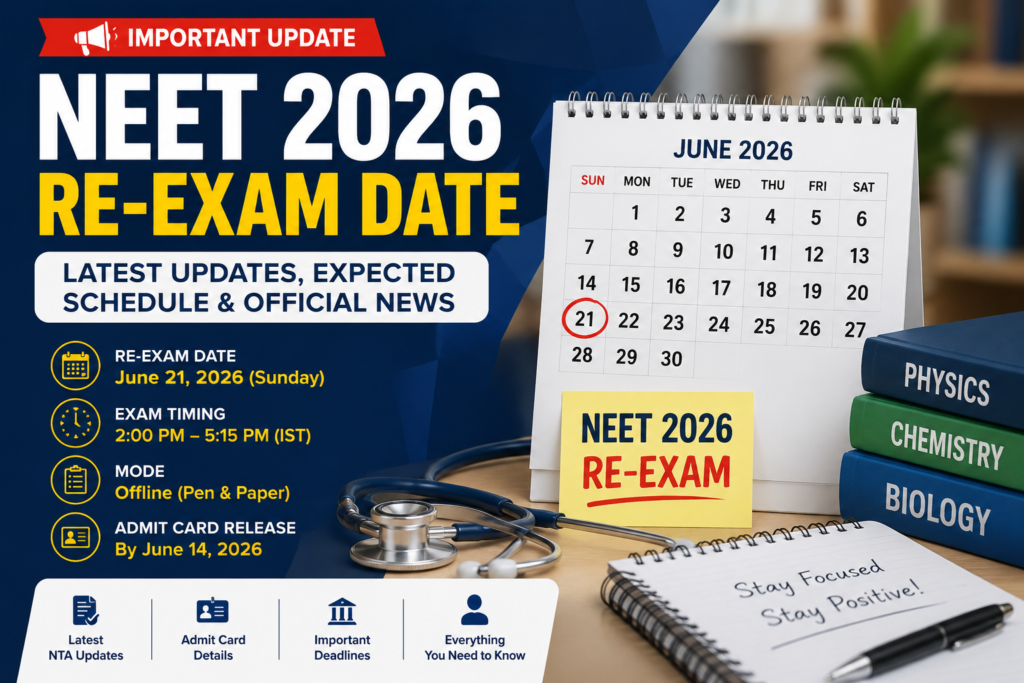
The NEET 2026 exam date has become one of the most searched topics among medical aspirants after the National Testing Agency (NTA) officially cancelled the earlier examination conducted on May 3, 2026. Following serious allegations of paper leaks and exam irregularities, lakhs of students across India were left confused, stressed, and uncertain about their future.Now, with the announcement of the NEET UG 2026 re-exam date, students are actively searching for official updates, admit card details, city correction deadlines, and preparation strategies for the fresh examination. In this article, we bring you the latest official news, expected schedule, important deadlines, and everything candidates must know about the NEET 2026 re-examination.Students who are still unfamiliar with the medical entrance process can also read our detailed guide on What is NEET? Full Guide for Students (2026). NEET 2026 Re-Exam: Key Dates at a Glance Event Date / Details Original Exam Date May 3, 2026 (Cancelled) Re-Exam Date June 21, 2026 (Sunday) Exam Timing 2:00 PM to 5:15 PM (IST) — 195 minutes Mode Offline (Pen and Paper) in 13 languages City Change Window Closes May 21, 2026 (11:50 PM) Admit Card Release By June 14, 2026 Registration Fee No fresh registration required Exam Fee Refund Full refund for May 3 fees The original NEET UG 2026 examination conducted on May 3, 2026, was cancelled following the surfacing of serious evidence that the integrity of the exam had been compromised. Multiple reports confirmed instances of leaked question papers circulating before the actual test. The controversy triggered widespread outrage among lakhs of medical aspirants across India. As a result, in a press conference held on May 15, 2026, the NTA officially announced that: The May 3, 2026 exam results would be scrapped entirely. A fresh re-examination would be conducted for all registered candidates. No new registration would be required, and no additional fee would be charged. The exam fees paid for the May 3 test would be fully refunded. The NTA has extended the exam duration by 15 minutes specifically to accommodate pre-examination formalities and ensure a smooth entry process at all test centres nationwide. NEET 2026 Re-Exam Admit Card: When Will It Be Released? Fresh admit cards for the NEET UG 2026 re-examination are expected to be released by June 14, 2026. Candidates must download their new admit card from the official NTA NEET portal. The earlier admit cards issued for the May 3 exam will not be valid for the re-exam. Steps to download the NEET 2026 Re-Exam Admit Card: Visit the official NTA NEET portal: neet.nta.nic.in Click on the ‘Download Admit Card’ link for the re-examination. Enter your Application Number and Date of Birth. Download and take a printout of the admit card for exam day. City Change Window for NEET 2026 Re-Exam In a significant relief to candidates, the NTA has opened a special City Change Window, allowing students to update their present address and modify their exam city preference for the re-examination. This correction window closes on May 21, 2026 (11:50 PM). Candidates who wish to appear from a different city must act before this deadline. Registration & Fees: What Candidates Need to Know One of the most reassuring announcements from NTA is the fee structure for the re-examination: No fresh registration is required for the re-exam. Candidates who appeared in the May 3, 2026 exam are automatically registered for the re-exam. No new fees will be charged for the re-examination. The original exam fees paid for the May 3 test will be fully refunded to all candidates. How to Prepare for NEET 2026 Re-Exam in the Remaining Time With the re-exam scheduled for June 21, 2026, candidates now have a valuable window to consolidate their preparation.Here are some strategic tips: Revise NCERT thoroughly — Biology, Physics, and Chemistry chapters are non-negotiable. Focus on weak areas identified from the May 3 exam attempt. Practice full-length mock tests under timed conditions (195 minutes). Revisit previous years’ NEET question papers (2018–2025) for pattern familiarity. Avoid new topics; consolidate what you already know. Maintain a healthy routine — adequate sleep and nutrition are critical during exam prep. Candidates preparing for the re-exam can also check our complete analysis on How Many Marks Are Required in NEET for MBBS? How FenceMbbsEdu Can Help You At FenceMbbsEdu, we are committed to keeping every NEET aspirant informed and prepared with: Live updates on NEET 2026 exam date announcements and NTA notifications. Free and premium NEET mock tests aligned with the latest NTA pattern. Expert-curated subject-wise study material for Biology, Physics, and Chemistry. Counselling guidance for MBBS admissions in India and abroad. One-on-one mentorship sessions with experienced NEET faculty. Bookmark this page and follow us on social media for real-time updates on the NEET 2026 re-exam date, admit card, and result announcements. Contact Us Book Your Free MBBS Counseling FAQs: NEET 2026 Re-Exam Date Q1. What is the NEET 2026 re-exam date? The NEET UG 2026 re-exam is officially scheduled for June 21, 2026 (Sunday). Q2. Why was the NEET 2026 exam cancelled? The original May 3, 2026 exam was cancelled due to confirmed allegations of question paper leaks and serious exam irregularities. Q3. Do I need to register again for the NEET 2026 re-exam? No. All candidates who registered for the May 3 exam are automatically eligible for the re-exam. No new registration or fee is required. Q4. When will the NEET 2026 re-exam admit card be released? Fresh admit cards are expected to be available by June 14, 2026 on the official NTA portal. Q5. Can I change my exam city for the re-exam? Yes. The NTA has opened a City Change Window that closes on May 21, 2026 (11:50 PM). Candidates must update their preferences before this deadline. How FenceMbbsEdu Can Help You At FenceMbbsEdu, we are committed to keeping every NEET aspirant informed and prepared with: Live updates on NEET 2026 exam date announcements and NTA notifications. Free and premium NEET mock tests aligned with the latest NTA pattern. Expert-curated subject-wise study
What to Do After NEET Results? Complete Guide 2026

Choosing what to do after NEET results can feel overwhelming for many students. After months or even years of preparation, your score finally decides the direction of your medical career. But here’s the truth—your NEET result is not the end, it’s just the beginning of your journey.Every year, lakhs of students appear for NEET, yet only a small percentage secure MBBS seats—especially in government colleges. This leaves many students confused about their next step. Should you go for counselling, take a drop, choose a private college, or consider studying MBBS abroad?In this complete guide, you will understand what to do after NEET results in 2026, explore all available options, and make a smart decision for your future. What is NEET? Before making any decision, it’s important to understand the exam itself. NEET (National Eligibility cum Entrance Test) is the national-level entrance exam required for admission into MBBS, BDS, and other medical courses in India. The exam is based on Physics, Chemistry, and Biology and is conducted out of a total of 720 marks. Your score and rank determine your eligibility for medical colleges across India. Since NEET is the only gateway for medical admissions, your performance directly impacts your opportunities—but it doesn’t define your entire future. Understanding Your NEET Result First Before jumping to conclusions, take time to properly analyze your result. Focus on: Your NEET score Your All India Rank (AIR) Your category rank Previous year cutoff trends Step 1: Participate in NEET Counselling The first and most important step after NEET results is participating in the counselling process. This is where medical seats are allotted based on your rank and preferences. Types of Counselling All India Quota (AIQ) – 15% seats State Quota – 85% seats Deemed & Private Universities Counselling Even if your score is not very high, you should still participate, as cutoffs can vary and opportunities may arise in later rounds. NEET Counselling Process (Step-by-Step Guide) Understanding the counselling process can help you avoid mistakes and increase your chances of securing a seat. Step 1: RegistrationUnderstanding the counselling process can help you avoid mistakes and increase your chances of securing a seat.Step 2: Choice Filling Select colleges and courses based on your preference and rank. This step plays a crucial role in your admission. Step 3: Seat Allotment Seats are allotted based on rank, category, and choices filled.Step 4: Reporting to College If allotted a seat, you must confirm your admission by reporting to the college. Step 5: Upgradation (Optional) You can participate in further rounds to get a better college if needed. Important Tips for Counselling Fill as many choices as possible Do not skip counselling rounds Keep all documents ready Make informed decisions before locking choices Step 2: Know Your Chances Based on Score Your NEET score plays a major role in deciding your options. Here’s a general idea: 600+ Marks Strong chances for government medical colleges Access to top colleges 500–600 Marks Possible government seat (depending on category/state) Good semi-government options 350–500 Marks Limited government chances Private colleges become a key option Below 350 Marks Government seat unlikely Consider alternative paths like MBBS abroad Step 3: Explore All Your Options After understanding your score, the next step is to choose the best path forward. Option 1: Government Medical Colleges (Best Option) Government colleges are highly preferred due to: Affordable fees High-quality education Strong academic reputation However, limited seats and intense competition make admission challenging. Option 2: Private Medical Colleges in India Private colleges are a practical option for students with moderate scores. Pros: Easier admission compared to government colleges No need to drop a year Cons: High fees (₹80 lakh – ₹1.5 crore) Financial burden for many families Option 3: Drop a Year and Reattempt NEET Taking a drop year is a common choice for many students. When it makes sense: Your score is close to the cutoff No need to drop a year Risks: No guarantee of better results Increased competition and pressure Option 4: Study MBBS Abroad (Smart Alternative) Studying MBBS abroad has become a popular option for students who qualify NEET but don’t secure a seat in India. Benefits: Affordable fees compared to private colleges Globally recognized degrees No donation required Simple admission process Why the Philippines Is a Preferred Choice Among various countries, the Philippines has emerged as a top destination for Indian students. Its education system is aligned with global standards while remaining accessible and student-friendly. The curriculum emphasizes both theoretical learning and practical exposure, helping students adapt easily and build strong clinical skills. Key Advantages: English-medium education US-based curriculum High FMGE/NEXT success rate Strong clinical exposure Easy adaptation for Indian students NEET Qualification vs Admission Reality One of the biggest misunderstandings is that qualifying NEET guarantees an MBBS seat. Reality: NEET qualification = Eligibility for counselling Admission = Depends on rank, seats, and competition This is why many students with decent scores still do not secure admission in India. Common Mistakes Students Make After NEET Results Avoid these mistakes to make a better decision: Waiting too long to take action Focusing only on government colleges Ignoring financial planning Taking a drop without a strategy Not seeking proper guidance Smart Strategy After NEET Results After NEET results, many students feel confused or pressured to make quick decisions. However, rushing without a proper plan can lead to mistakes that affect your future. Instead of focusing only on your score, it’s important to take a structured and practical approach that aligns with your career goals.Instead of panicking, follow a clear plan: Analyze your score carefully Participate in counselling Keep backup options ready Compare India vs abroad options Make decisions based on long-term goals Quick Comparison: India vs Abroad Factor Government College Private College MBBS Abroad Fees Low Very High Affordable Competition Very High Medium Low Admission Difficult Moderate Easy NEET Requirement High Score Moderate Qualifying Only Frequently Asked Questions (FAQs) How many marks are required in NEET for MBBS? The marks required in NEET for MBBS depend